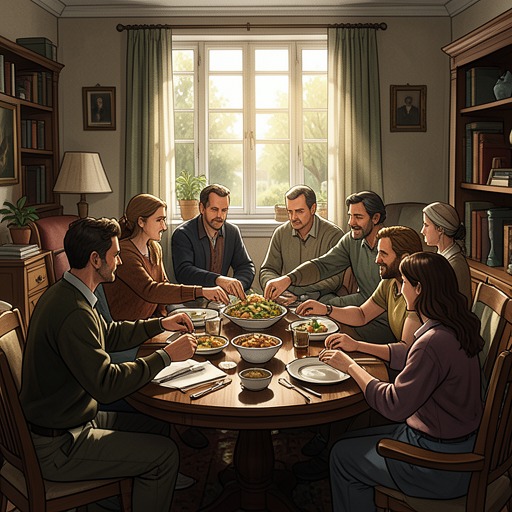
Gu Family Main House
I’m Very Happy After Marrying the CEO Husband According to the AgreementGu Family Main House functions as the Gu family’s principal household and as a testing ground for belonging. It is not merely a backdrop for domestic visits: news, concern, family approval, and social standing all travel through it. Shen Tang’s relationship to the house begins in tension, but the household gradually becomes a place where her position as Gu Huaian’s wife is acknowledged and publicly reinforced.
The House and Its Authority
Gu Family Main House is associated with the older generation of the Gu family, particularly Old Madam Gu and Old Master Gu. Their attitude toward Shen Tang determines how other relatives respond to her, giving the house a clear social hierarchy. The household therefore operates as both a residence and an informal institution: acceptance from its senior figures carries consequences beyond private affection, shaping the behavior of the wider family.
The house also embodies different forms of family authority. Uncle He, who comes from the main house, is described as stern in contrast with his warm brother, though the two resemble each other physically. His arrival brings the authority of the household into Shen Tang’s immediate life without requiring Gu Huaian to mediate it. Through him, the main house reaches outward to the couple’s villa and establishes that Shen Tang’s condition is being observed and taken seriously.
A Visit After Shen Tang’s Injury
After Shen Tang returns to her villa, Uncle He visits from Gu Family Main House. His presence initially makes her tense because she cannot understand why he has come or how much the household knows about her recent troubles. The uncertainty is important: Shen Tang is aware of public scandals and personal dangers, and she wonders whether those matters have also reached the older members of the Gu family.
Her apprehension changes when Uncle He reveals the purpose of the visit. He has brought a pile of supplies and a black card, explaining that Old Madam Gu specifically ordered them sent after hearing of Shen Tang’s injury and is deeply concerned about her. The objects transform the visit from an inspection into an act of material care. The main house does not offer only words; it sends practical assistance, making concern tangible and giving Shen Tang evidence that she has been included in the family’s circle of responsibility.
Family Recognition and Social Position
The main house’s significance becomes especially clear during a larger family gathering. Old Madam Gu and Old Master Gu’s warm attitude toward Shen Tang establishes the tone for the other Gu family members. Old Madam Gu introduces Shen Tang to several important elders before allowing the younger people to spend time on their own. This sequence places Shen Tang within the family’s formal network rather than leaving her as an outsider attached to Gu Huaian only through a private marriage arrangement.
The gathering shows that family recognition is collective but centrally directed. The older generation’s acceptance functions almost like a social declaration, encouraging relatives to take note of Shen Tang and treat her as someone with a legitimate place in the household. Gu Huaian’s embarrassment in front of Old Madam Gu further emphasizes the intimacy and generational pressure of the setting: the house can make private relationships publicly legible while also exposing the younger generation to the older generation’s scrutiny.
Domestic Space and the Meaning of Family
Gu Family Main House stands in contrast to the more provisional or transactional spaces that surround Shen Tang’s life. She has an orphanage that serves as an emotional home, a contractual marriage that begins as an agreement, and a villa connected to her married life, but the main house represents inherited family structure and continuity. Its gestures toward her do not erase the uncertainties of those other relationships; instead, they place her inside a larger system of kinship and obligation.
That system also complicates the idea of who counts as family. Shen Tang spends her savings caring for an eight-year-old orphanage child with leukemia, even though he is not her biological brother, while the Gu household extends care to her through marriage and family affiliation. The contrast suggests that family in the narrative is defined not only by blood but also by sustained responsibility. Gu Family Main House gives that principle an institutional form: concern becomes supplies, a black card, introductions, and public recognition.
Narrative Significance
The house marks a shift in Shen Tang’s status. At first, she approaches its influence defensively, worried that information about her scandals and injury may have reached people whose judgment matters. The visit from Uncle He reverses that expectation by revealing protection rather than condemnation. Later, the older generation’s public welcome confirms that her place in the Gu family is no longer merely private or contractual.
Its recurring function is therefore one of conversion: anxiety becomes reassurance, an individual marriage becomes family membership, and an uncertain outsider becomes a recognized relative. Gu Family Main House gathers the novel’s questions about blood, marriage, care, and authority into one domestic center, showing that belonging is established through both ceremonial acknowledgment and concrete acts of protection.